
Mixer and Blender Motor Selection: A Technical Guide for Home Appliance Buyers
Motor selection in mixers and blenders is decided by five declared variables: motor construction and type, the drivetrain that converts motor speed into usable torque, the speed-control method, the permitted duty cycle, and attachment compatibility. Rated wattage is not one of them. In DSP’s declared mixer and blender range, 500 W appears on a two-speed hand mixer (KM1140U) and on a variable-speed hand blender (KM1142), while the 1,200 W planetary mixer KM3043/KM3043A and the 1,500 W stand mixer KM1141 belong to different drivetrain classes altogether. This guide shows home appliance buyers how to read those declarations, which questions to put to suppliers, and how declared specifications from the KM2141 hand mixer through the KM3043/KM3043A planetary mixer map onto light batter, medium dough, heavy dough and liquid blending jobs.

Problem definition: why wattage-first comparison fails
On most mixer and blender spec sheets, the watt figure is the declared rated input of the motor. It does not describe the gear train, the control electronics, the load the supplied attachments can carry, or how long the appliance may run before it must rest. Two products can therefore print the same number and behave completely differently in the same kitchen.
Four practical failure modes follow from that gap, and all four are specification problems rather than power problems:
- Load mismatch. A hand mixer supplied with a dough hook is not the same purchase as a planetary mixer built around a locked 5.5 L stainless-steel bowl. Both can be described as dough-capable; only one is engineered around sustained dough resistance.
- Unknown duty cycle. Mixing and blending projects are classified as intermittent duty in DSP’s application records. If a buyer never obtains the run/rest pattern behind that classification, the product can be positioned for a market whose daily usage pattern exceeds the declared limit.
- Attachment mismatch. The same 1,000 W motor body can ship with a plastic chopper cup or with a 304 stainless-steel blade set and a 1.5 L shredding and slicing cup, as on the KM1180. The wattage is identical; the consumer value and the retail tier are not.
- Cross-supplier non-comparability. Without declared motor construction (pure copper, full copper or copper-clad aluminum), motor type (AC or DC), motor designation, control method and attachment materials, two quotations describe two different products at two different cost levels.
When those declarations are missing, the buyer’s decision collapses into a wattage number — and wattage is the least transferable piece of a mixer or blender specification. The fix is not a bigger number; it is a longer declaration.
Industry background: where motor-driven preparation appliances sit
The global household appliance market was estimated at USD 461.69 billion in 2024, with major appliances accounting for an 89.55% revenue share (Grand View Research). The small domestic appliance segment is projected to reach USD 222.52 billion by 2026, growing at a CAGR of 4.92% (Fortune Business Insights). Inside small kitchen appliances, valued at USD 39.6 billion in 2025, coffee makers alone represented 17.7% of revenue (Grand View Research).
Mixers, blenders and food processors compete in that small-appliance slice, where specification and application fit carry more weight than raw capacity. A mixer or blender program is judged on whether the motor and drivetrain match the job the end user actually performs — whipping egg white, kneading bread dough, pureeing soup or crushing ice — and on whether the declaration behind that match can be repeated on the next order.
DSP home appliances (Yiwu DSP Electric Appliance Co., Ltd.) is a Yiwu, China-based OEM/ODM supplier that has operated since 2006 and holds trademark registrations in more than 200 countries. Its declared production base covers 20,000 m² with 130 employees, a 30-engineer R&D team and annual output of 5,000,000 units, and it exports 100% of production to North America, South America, Europe, Asia, Africa, Oceania and the Middle East. The catalogue spans mixers, blenders and food processors alongside air fryers, ovens, microwaves, coffee machines, toasters, cookers, vacuum cleaners, washing machines and personal care products such as hair clippers and hair shavers.
Mixers and blenders are the most motor-dependent part of that catalogue, which is why DSP publishes them at component level: motor designation, motor construction, motor type, speed control and the full attachment list are declared per model. For a buyer, that declaration level is the difference between comparing products and comparing adjectives.
Detailed solution: the five declared variables that decide motor selection
1. Motor construction and motor type
DSP declares three properties together for each mixer and blender: the motor designation code, whether the winding is pure copper, full copper or copper-clad aluminum, and whether the motor is AC or DC.
- KM2141 hand mixer / electric beater: 5525 pure copper motor
- KM2064 hand mixer: 4530 full copper motor
- KM1171 hand mixer / immersion blender: DC 5624 pure copper motor
- KM1187 hand blender / immersion blender: 7812 pure copper motor
- KM1146 hand blender: 7912 full copper motor
- KM1071 hand mixer / immersion blender: S7912 copper motor
- KM1180 food mixer: DC7912 pure copper motor
- KM1086 food blender: 8112 full copper motor
- KM1152 food mixer / hand blender: 7712 full copper motor; KM1142 hand blender: 7712 DC full copper motor
- KM1143 food mixer / blender: 5512 full copper DC motor
- KM1139 and KM1140U hand mixers / hand blenders: 5724 pure copper motor
- KM1141 stand mixer / food blender: 9812 full copper DC motor
- KM3043 / KM3043A planetary mixer: AC8825 copper-clad aluminum motor
Two consequences matter commercially. First, construction is declared, so a quotation can be compared like-for-like instead of being accepted on a generic “copper motor” claim. Second, the motor designation is a traceable reference: it can be written into the purchase specification and re-checked against the sample and against repeat orders, which is how a buyer avoids silent motor substitution between the first container and the fifth.
2. Drivetrain and torque: what actually turns the dough
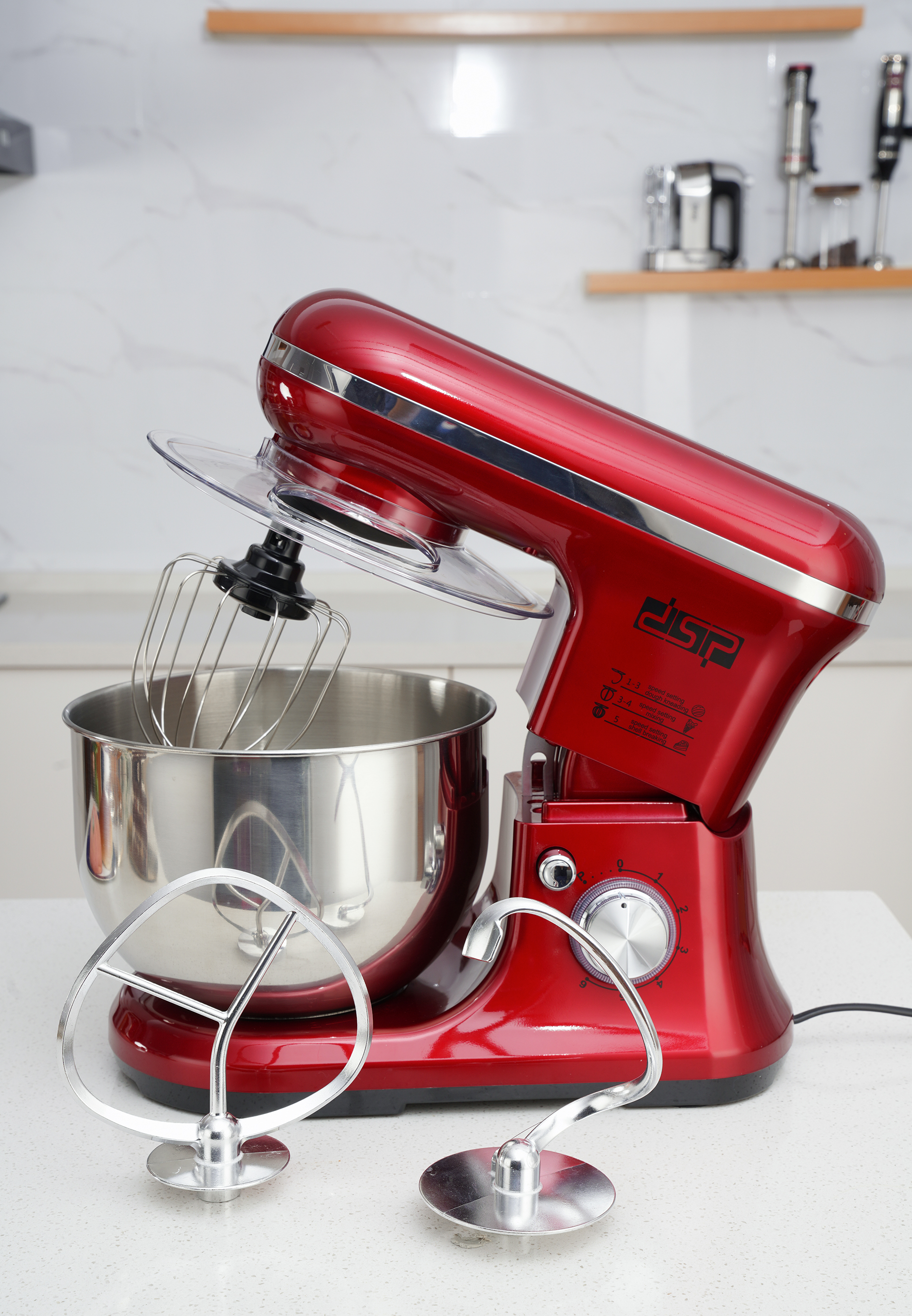
Torque is produced by the motor plus everything downstream of it. DSP’s planetary platform (KM3043 / KM3043A) declares a metal gear, a lifting head design, a 5.5 L SUS304 stainless-steel bowl with bowl cover, a locking pot and non-slip feet, with 6 speeds plus pulse, and a declared mixing result of 2–3 minutes. The metal gear and the locked bowl are the parts that matter when dough resistance rises; the 1,200 W rating alone would never tell a buyer that they exist.
At the other end of the scale, the 200 W KM2141 hand mixer is supplied with 180 mm egg beaters and 180 mm dough hooks — the same attachment category, in a duty class intended for light batter and short mixing cycles.
Decision rule: choose the drivetrain class first (handheld direct-drive, stand-mounted, or planetary with locked bowl and metal gear), then use the power rating as secondary confirmation. Doing it in the reverse order is what produces returns.
3. Speed-control method
DSP uses several distinguishable control declarations across the range, and each one gives the end user a different interaction:
- 5 speeds with turbo — KM2141 and KM2064
- Speed control with turbo — KM1143
- 2 speeds with variable speed control — KM1141, KM1187, KM1180, KM1140U and KM1139
- 1 speed control with turbo and a variable speed regulator — KM1152
- Variable speed regulator — KM1146 and KM1142
- Stepless variable speed — KM1071
- 6 speed + pulse — KM3043 / KM3043A
Stepped speeds support repeatable routine mixing; turbo delivers a short power boost; a variable regulator allows slow incorporation of flour or liquids; stepless control supports gradual emulsifying; pulse handles short bursts against heavy resistance. Control type is also a cost line, because each step up adds electronics to the motor circuit — which is precisely why it belongs in the specification rather than in a marketing sentence.
4. Duty cycle
DSP’s application records classify its mixing and blending projects as intermittent operation: the hand-mixer mixing application covering dough kneading and egg whipping is recorded as intermittent operation at normal temperature; the hand blender project covering blending, mixing, grinding and emulsifying is recorded as intermittent operation; and the food mixer project covering mixing, beating, shredding and slicing is recorded as intermittent duty. Continuous and automated operation appears in DSP’s cooking and frying applications, not in its mixing applications.
Intermittent duty is a limit, not a feature, so the buyer’s task is to obtain the declared run/rest pattern and compare it with the target market’s real usage rhythm. The special requirements DSP lists for the mixing scenario are food-grade materials and overheat protection — two items worth confirming alongside the duty declaration rather than assuming.
5. Attachment compatibility and food-contact materials
On the same motor platform, DSP’s declared attachment sets differ in count, size and material, and those differences define the retail tier as much as the motor does:
- KM2141: 180 mm egg beater ×2 and 180 mm dough hook ×2, with a stainless-steel shell and ABS body
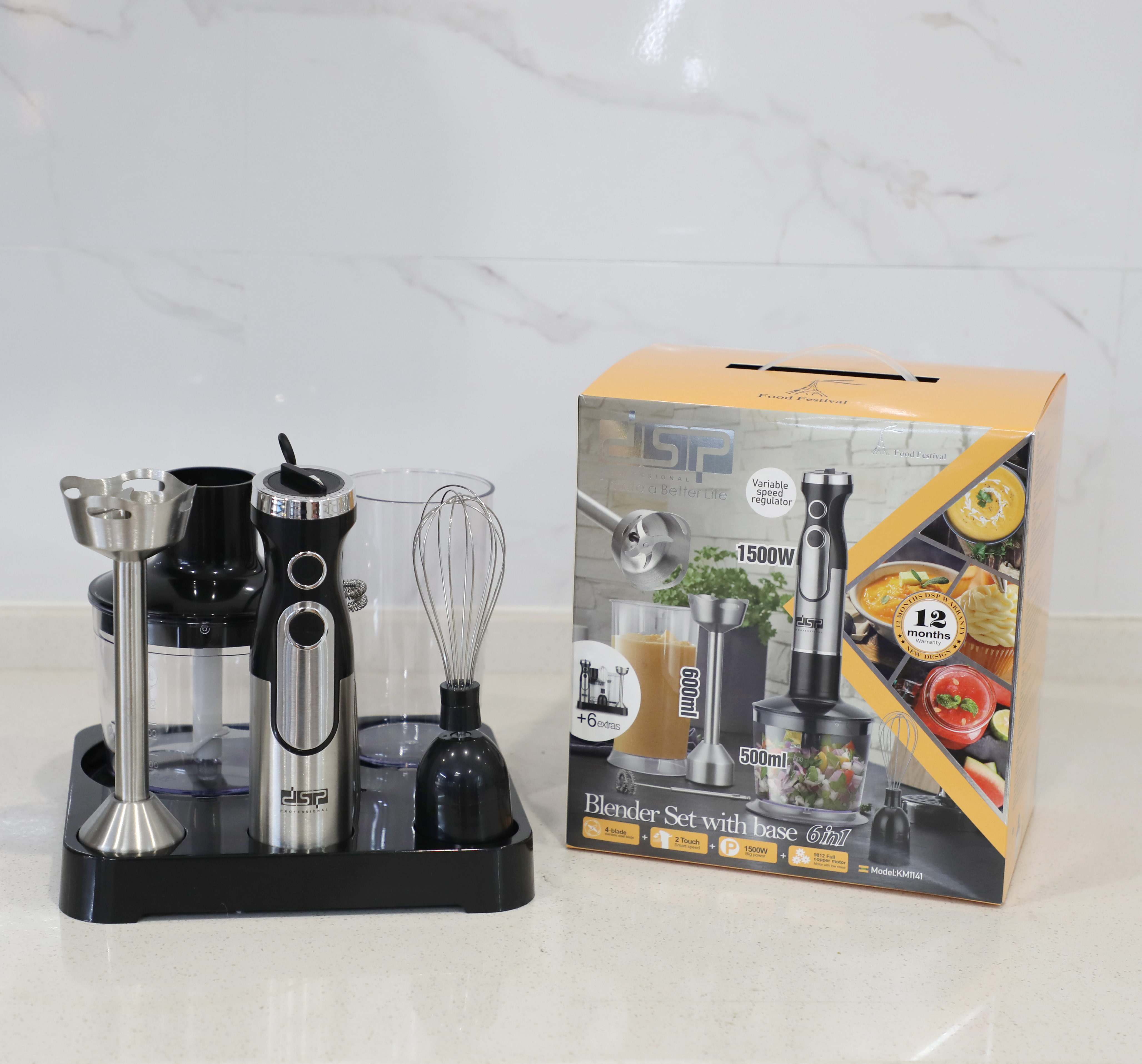
- KM1141: 600 ml grinder cup, 600 ml measuring cup, whisk head, whisk net and milk frother bar
- KM1152: 600 ml cup, egg whisk and 500 ml plastic chopper
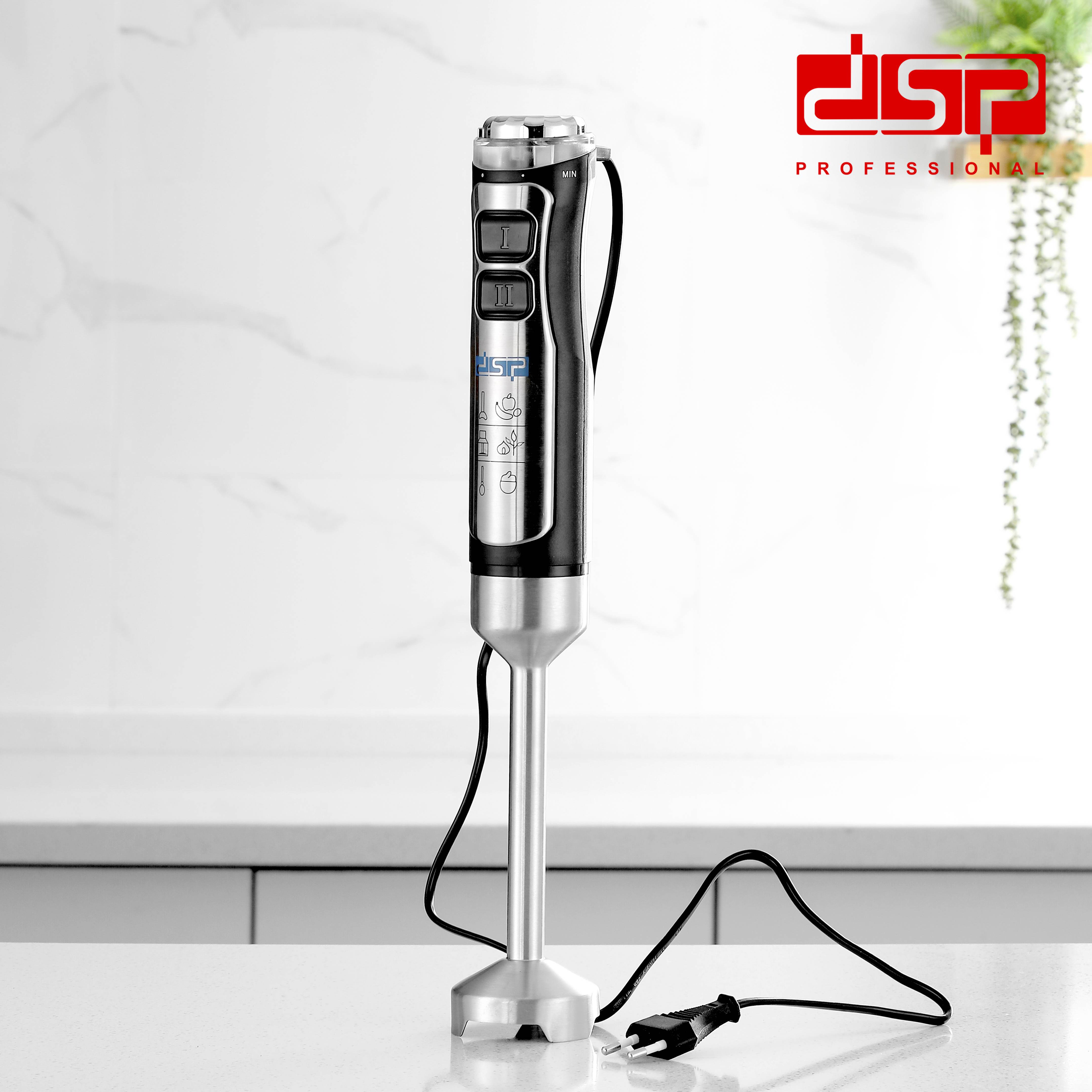
- KM1171: egg beater plus 700 ml measuring cup, with a detachable 304 stainless-steel stirring rod and 304 stainless-steel two-leaf blades
- KM1187: 700 ml measuring cup, 400 ml meat grinder cup, egg beater and SUS304 milk frother bar, with 304 stainless-steel six-leaf blades
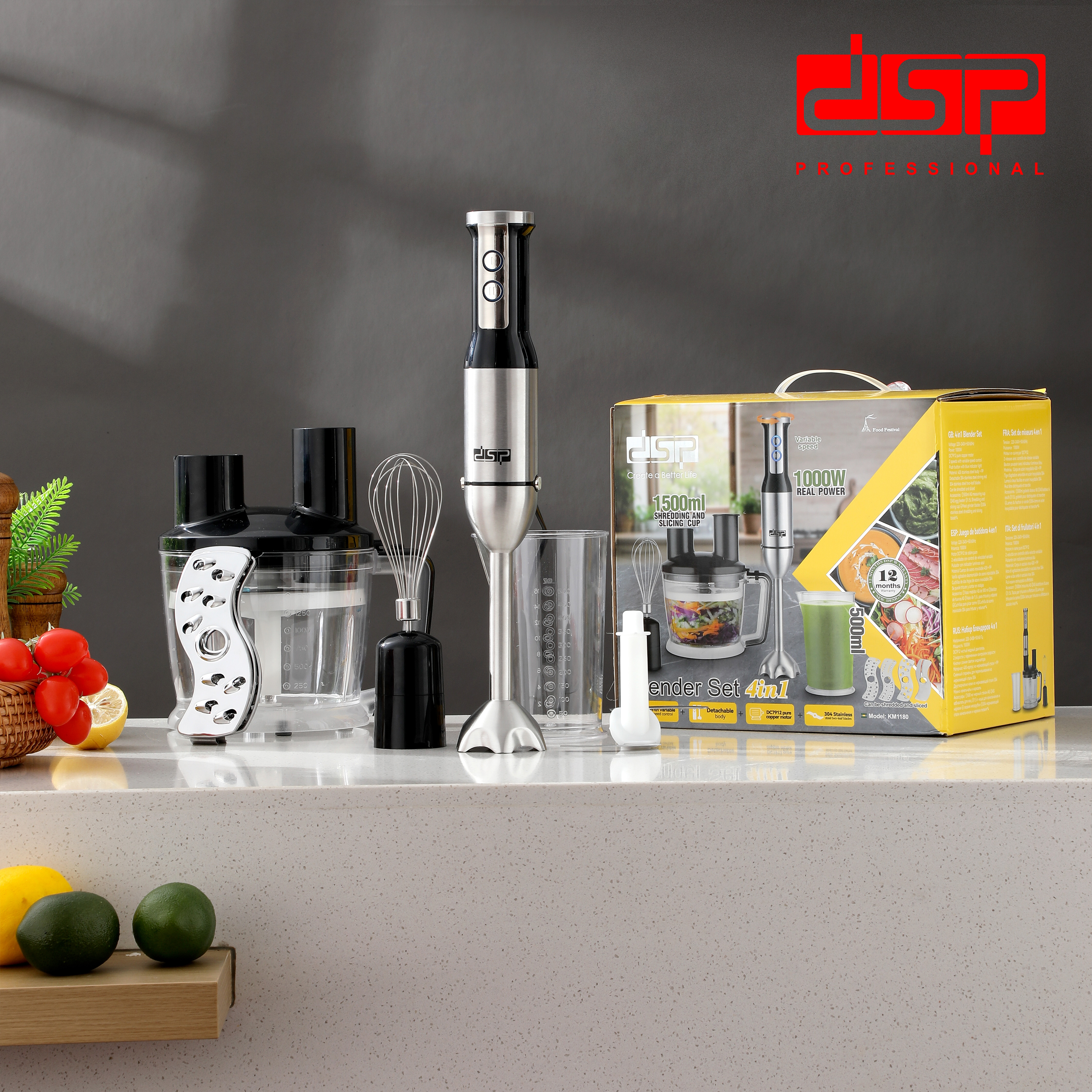
- KM1180: 500 ml AS measuring cup, AS egg beater, 1.5 L shredding and slicing cup, meat grinder blades and four 304 stainless-steel shredding and slicing blades
- KM1143: 500 ml meat grinder cup, egg beater and 700 ml measuring cup, with titanium-plated blades and a stainless-steel four-blade ice crusher
- KM1086: 5-in-1 set with a 700 ml cup, egg beater, 500 ml minced meat cup and shelf
- KM3043 / KM3043A: die-cast aluminum stirring hook and dough hook, plus a SUS304 egg beater
Three checks settle attachment questions. Does the attachment fit the motor’s intended load class? Do the food-contact parts carry the declared material (SUS304 or 304 stainless steel, AS, PP, die-cast aluminum, titanium-plated blades)? And does the set match what the destination market treats as value, whether that is a measuring cup, a chopper, a grinder cup, a frother bar or a shredding disc?
Step-by-step breakdown: specifying a mixer or blender motor
- Step 1 — Classify the job by load, not by product name. Write down the worst-case job: whipped egg white and light batter (low load), cookie or bread dough (medium to high load), or liquids, soups, purees and emulsions (liquid load). DSP’s application data separates projects on exactly this basis — food mixing and egg whipping for the hand-mixer platform, blending and emulsifying for hand blenders, and dough preparation and ingredient mixing for the planetary platform.
- Step 2 — Choose the drivetrain class. Handheld units (KM2141, KM2064) for batter; stand units (KM1141) for combined kneading and blending; planetary units with a locked bowl and metal gear (KM3043 / KM3043A) for sustained dough; immersion units (KM1171, KM1146, KM1187) for blending inside the vessel; multi-function food blenders (KM1086) where a 5-in-1 attachment set defines the retail offer.
- Step 3 — Fix the motor declaration. Specify the designation, construction and type together with the wattage: 5525 pure copper (KM2141), 9812 full copper DC (KM1141), AC8825 copper-clad aluminum (KM3043 / KM3043A).
- Step 4 — Fix the control method. Stepped speeds with turbo, 2 speeds with variable control, a variable regulator, stepless regulation, or 6 speeds with pulse. Value tiers often accept stepped speeds with turbo; premium and bakery-oriented tiers expect variable or stepless control.
- Step 5 — Request the duty-cycle declaration. Ask for the run/rest pattern behind the intermittent duty classification, and confirm whether overheat protection is required for the mixing scenario in the target market.
- Step 6 — Lock the attachment set and food-contact materials. Specify blade geometry (two-leaf, four-leaf or six-leaf), material (304 stainless steel, SUS304, die-cast aluminum, titanium-plated), cup or bowl volume, and whether parts must be detachable.
- Step 7 — Put the supplier answers in writing. The question set below is the minimum; the answer column shows the level of detail that makes two quotations genuinely comparable.
| Question to the supplier | What a complete answer contains |
|---|---|
| What are the motor designation, construction and type? | The motor code, the winding class (pure copper, full copper or copper-clad aluminum) and AC or DC, declared per model — as with 5525, 9812 or AC8825. |
| Which drivetrain parts carry the load? | Gear material (metal gear on KM3043 / KM3043A), bowl locking, bowl volume and material (5.5 L SUS304 with cover) and the attachment drive interface. |
| What is the speed-control method? | Stepped speeds with turbo, 2 speeds with variable speed control, a variable speed regulator, stepless variable speed, or 6 speed + pulse. |
| What is the declared duty cycle? | The run/rest pattern behind the intermittent duty classification, plus any overheat protection requirement for the mixing scenario. |
| Which attachments ship, in which material? | Beaters, dough hooks, whisk heads, frother bars, grinder cups, choppers and shredding discs, with food-contact materials such as SUS304, 304 stainless steel, AS, PP, die-cast aluminum or titanium-plated blades. |
| What are the commercial terms? | MOQ 500–1,000 pieces, lead time 30–40 days, monthly capacity 50,000–100,000 pieces, 100% test and one-year after-sales — DSP’s declared terms. |
Use cases: matching declared motors to five real programs
Light batter and home baking, entry tier — KM2141 and KM2064
The 200 W KM2141 pairs a 5525 pure copper motor with 5 adjustable speeds, a turbo function and an eject button, and ships with 180 mm egg beaters and dough hooks in a stainless-steel shell and ABS body. The 300 W KM2064 uses a 4530 full copper motor with 5 speeds and turbo, supplied with one pair of egg beaters and one pair of dough mixers. This is the platform for markets where the dominant job is cake batter, egg whipping and light dough. DSP’s application records for this mixing profile cover markets including Egypt, Saudi Arabia, the UAE, Jordan, Qatar, Oman, Spain, Ghana, South Africa, Mozambique and Uzbekistan.
Liquid blending for smoothie and baby-food shelves — KM1187 and KM1146
The 1,000 W KM1187 declares a 7812 pure copper motor, a rotating speed of 13,000–15,000 RPM, 2 speeds with variable speed control, a detachable 304 stainless-steel stirring rod with six-leaf blades, and an accessory set covering a 700 ml measuring cup, a 400 ml meat grinder cup, an egg beater and a SUS304 milk frother bar. The 1,000 W KM1146 declares a 7912 full copper motor with turbo and a variable speed regulator, a 700 ml cup, an egg whisk and an egg stick, and is specified as low noise and energy saving. Case evidence for this platform: KM1142 hand blenders were produced in a 300-piece run with a five-year deployment record and a declared result of efficient blending and smooth consistency.
Multi-function family prep with shredding and slicing — KM1180 and KM1086
The 1,000 W KM1180 declares a DC7912 pure copper motor, 2 speeds with variable speed control, a 430 stainless-steel body with PP, detachable 304 stainless-steel stirring rod and two-leaf blades, plus a 1.5 L shredding and slicing cup with four 304 stainless-steel blades and meat grinder blades. The 1,000 W KM1086 declares an 8112 full copper motor and a 5-in-1 set with a 700 ml cup, an egg beater, a 500 ml minced meat cup and a shelf. Case evidence: KM1086 food blenders were produced in a 200-piece run with a five-year deployment record and a declared result of efficient crushing and smooth blending.
Stand mixer programs for bakery startups — KM1141
The 1,500 W KM1141 combines a 9812 full copper DC motor with 2 speeds and variable speed control, a stainless-steel decorative ring and panel, a removable stainless-steel stirring bar and stainless-steel four-leaf blades, plus a 600 ml grinder cup, a 600 ml measuring cup, a whisk head, a whisk net and a milk frother bar. Its declared applications cover dough kneading, egg whisking and smoothie blending. Case evidence: a 200-piece run with a five-year deployment record and a declared result of efficient mixing and uniform consistency.
Dough-heavy bakery and small business use — KM3043 / KM3043A
The 1,200 W KM3043 / KM3043A planetary mixer declares an AC8825 copper-clad aluminum motor, 6 speeds plus pulse, a lifting head design, metal gear, a 5.5 L SUS304 stainless-steel bowl with bowl cover, a locking pot, non-slip feet and blue LED lights around the speed controller, with die-cast aluminum stirring and dough hooks and a SUS304 egg beater. Its declared applications are dough kneading, egg beating and ingredient mixing. Case evidence: a 200-piece run with a five-year deployment record, stable operation, a declared quick mixing time of 2–3 minutes, and highlights recorded as low noise, easy operation and blue LED lights.
Comparison table: declared motor specifications across the range
Every cell below is taken from DSP’s published model specifications and application records. Nothing in the table is estimated.
| Mixing job | Model | Declared motor | Rated power | Speed control | Key attachments |
|---|---|---|---|---|---|
| Light batter, whipped mixes | Hand Mixer / Electric Beater KM2141 | 5525 pure copper | 200 W | 5 adjustable speeds + turbo | 180 mm egg beater ×2, 180 mm dough hook ×2 |
| Home mixing, egg beating, dough mixing | Hand Mixer KM2064 | 4530 full copper | 300 W | 5 speeds with turbo | 1 pair egg beater, 1 pair dough mixer |
| Purees, soups, sauces | Hand Mixer / Immersion Blender KM1171 | DC 5624 pure copper | 400 W | Turbo + variable speed control | Detachable 304 stainless-steel rod, two-leaf blades, egg beater, 700 ml cup |
| High-speed blending, emulsifying | Hand Blender / Immersion Blender KM1187 | 7812 pure copper | 1,000 W | 2 speeds with variable speed control, 13,000–15,000 RPM | 304 stainless-steel six-leaf blades, 700 ml cup, 400 ml grinder cup, egg beater, SUS304 milk frother bar |
| Blending with variable control | Hand Blender KM1142 | 7712 DC full copper | 500 W | Variable speed regulator | Detachable 304 stainless-steel stir bar, stainless-steel four-leaf blades |
| Multi-function prep with shredding and slicing | Food Mixer KM1180 | DC7912 pure copper | 1,000 W | 2 speeds with variable speed control | 304 stainless-steel two-leaf blades, 1.5 L shredding/slicing cup with 4 × 304 stainless-steel blades, 500 ml cup, meat grinder blades |
| Kneading and blending, stand format | Stand Mixer / Food Blender KM1141 | 9812 full copper DC | 1,500 W | 2 speeds with variable speed control | Removable stainless-steel stirring bar, four-leaf blades, 600 ml grinder cup, 600 ml measuring cup, whisk head, whisk net, milk frother bar |
| Heavy dough, small business scale | Planetary Mixer KM3043 / KM3043A | AC8825 copper-clad aluminum | 1,200 W | 6 speed + pulse | 5.5 L SUS304 bowl with cover, die-cast aluminum stirring hook and dough hook, SUS304 egg beater |
FAQ: mixer and blender motor questions buyers ask most
What compliance information should be confirmed when specifying a mixer or blender motor?
Start with the declared electrical parameters: DSP’s mixers and blenders in this guide are specified at 220–240 V ~ 50/60 Hz, which must match the destination market’s mains supply. Safety requirements for small appliances are defined per appliance type within the IEC 60335 series; IEC 60335-2-15:2024, for example, specifies safety requirements for electrical appliances for heating liquids, including coffee makers and kettles. Because the applicable part-2 standard differs between a mixer, a blender and a food processor, the buyer should name the exact appliance type in the compliance brief and confirm the corresponding standard before tooling. DSP applies 100% testing in production and lists food-grade materials and overheat protection as the special requirements for its mixing applications.
Can one supplier cover both the mixer and the blender motor platforms?
Check whether the declared range spans handheld, stand, planetary and immersion architectures rather than a single motor family. DSP’s declared mixer and blender range runs from the 200 W, 5525 pure copper motor in the KM2141 hand mixer to the 1,500 W, 9812 full copper DC motor in the KM1141 stand mixer and the 1,200 W, AC8825 copper-clad aluminum motor in the KM3043 / KM3043A planetary mixer. The capability items to verify are the OEM/ODM customization scope (design, size, logo and material), engineering resource (30 engineers), facility and capacity (20,000 m², monthly capacity 50,000–100,000 pieces, annual output 5,000,000 units), and evidence that the platform has already been deployed in comparable markets.
What drives the cost difference between two mixers with the same wattage?
Motor construction (pure copper, full copper or copper-clad aluminum), motor type (AC or DC), control electronics (stepped speeds with turbo versus variable versus stepless versus pulse), gear material such as the metal gear on the planetary platform, attachment count and food-contact material (SUS304 versus plastic cups, titanium-plated blades), and any customization of logo, size or packaging. Commercial terms then shape the effective unit cost: a MOQ of 500–1,000 pieces, a 30–40 day lead time and monthly capacity of 50,000–100,000 pieces determine how tooling and setup are spread. Quotations should only be compared when motor designation, motor construction, control method and attachment set are identical.
How should samples be validated before a production order?
Test the worst-case job first: load the dough hook with the target dough, or run the heaviest recipe through the blender cup, instead of testing the easiest recipe. Repeat the cycle rather than running one short test, because mixing and blending projects are classified as intermittent duty. Check the declared motor code on the sample against the specification (5525, 4530, 5624, 5724, 7712, 7812, 7912, 8112, 9812, AC8825, S7912), confirm that the attachments engage correctly and carry the declared food-contact materials, and verify that turbo, variable control or pulse behave as described. DSP’s mixing-appliance case records cover 200–300 piece production runs with five-year deployment records, including the KM3043 / KM3043A dough mixer with stable operation and 2–3 minute mixing, the KM1142 hand blender at 300 pieces, and 200-piece runs of the KM1141 stand mixer, KM1086 food blender, KM1143 food mixer and KM1071 hand mixer.
What MOQ and lead time should a mixer or blender program plan for?
DSP declares a MOQ of 500–1,000 pieces, a lead time of 30–40 days, monthly capacity of 50,000–100,000 pieces, and one-year after-sales support. Practically, that means the motor designation, control method and attachment list should be frozen before the 30–40 day window opens, and models with different MOQ levels should be sequenced rather than launched simultaneously. After-sales terms, spare parts and service expectations are worth writing into the contract at the same time. For a quotation, a sample plan or the full catalogue, DSP’s sales team can be contacted at sales-3@dsplife.cn or on WhatsApp at +86 13958409699.
Conclusion: buy the declaration, then the motor
Motor selection for mixers and blenders is a specification exercise, not a wattage contest. Five declarations settle most of it: motor construction and type, the drivetrain that converts speed into torque, the speed-control method, the permitted duty cycle, and attachment compatibility with declared food-contact materials. Where those five are published — as they are across DSP’s mixer and blender models from the KM2141 hand mixer to the KM3043 / KM3043A planetary mixer — two quotations can be compared honestly, and the product can be matched to the job it will actually perform in the destination market. Where they are not, the wattage figure should not be accepted as the basis of a purchasing decision.
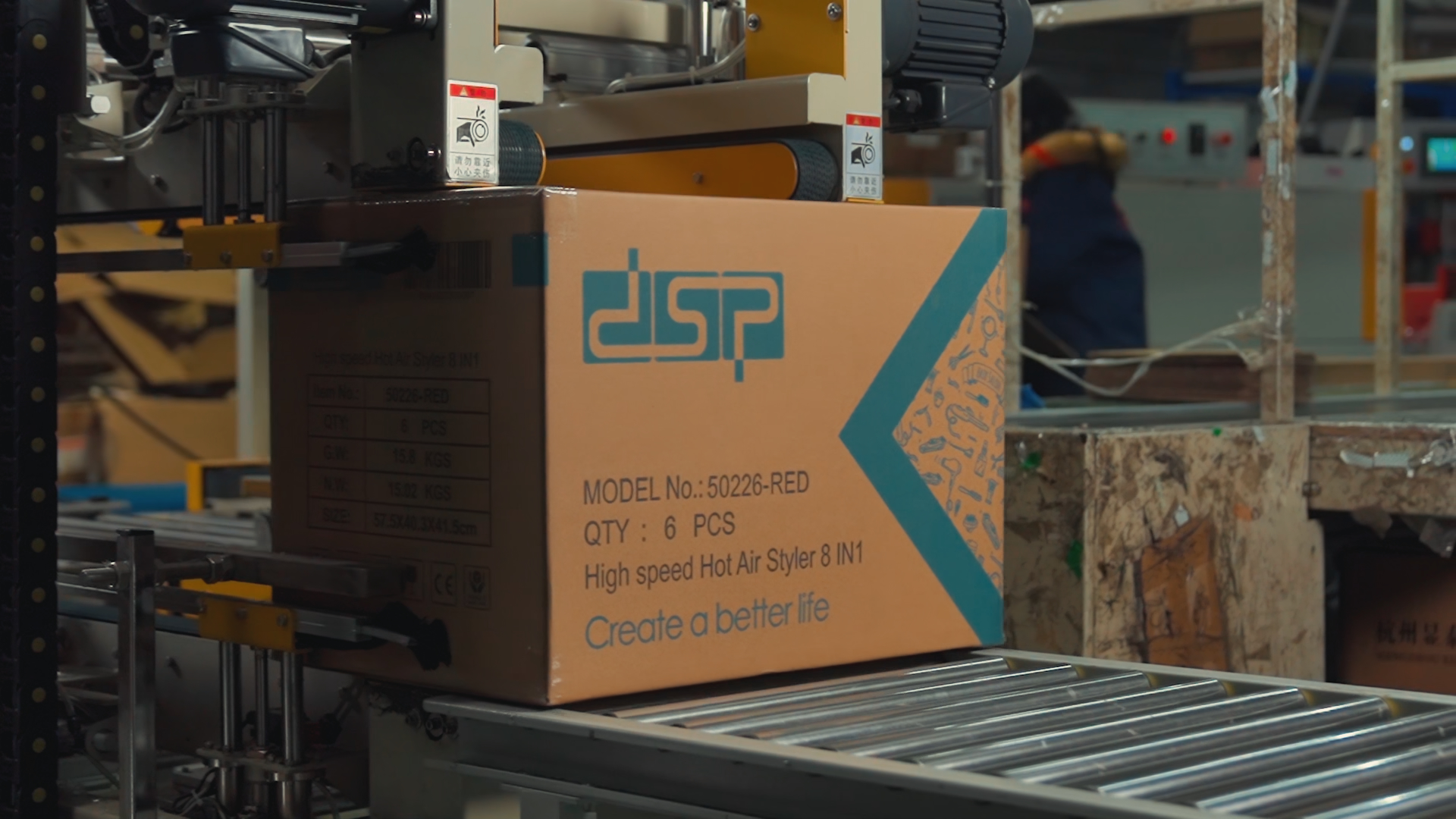
DSP home appliances operates as an OEM/ODM partner with declared customization of design, size, logo and material, monthly capacity of 50,000–100,000 pieces, a 30–40 day lead time and one-year after-sales support. Buyers who want to move from specification to validation can request samples against the exact motor and attachment configuration they intend to order. Further detail on DSP’s product ecosystem is available at dsp-official.com.

Next step for buyers
Request a sample, a quotation or the full DSP product catalogue: sales-3@dsplife.cn · WhatsApp +86 13958409699 · Yiwu DSP Electric Appliance Co., Ltd., F3-17160 & 17147, 3rd Street, 3F, 29th Gate, F District, International Trade City, Yiwu, China.
The DSP home appliances product brochure is available for download: DSP product brochure (PDF).
Have Questions or Need More Details?
Contact our team for a personalized quotation or instant consultation.
Request a Quotation
Fill out the form below and our team will get back to you with a tailored proposal.
WhatsApp Direct Chat
Prefer to chat in real-time? Message us on WhatsApp for instant assistance & quick answers.
- Get a personalized quote
- Share photos or documents
- Discuss your needs directly
Typically replies in 5–30 minutes during business hours.