
Mixing Solutions for Bakery Startups: Choosing the Right Equipment Scale
Mixing equipment for a bakery startup is sized by the heaviest batch you actually produce, the number of batches per session and the dough type — not by the largest motor within budget. For most home-based and small bakery operations the practical progression runs across three scales: a hand mixer for batters, creams and light dough; a stand mixer once mixing time becomes the daily bottleneck; and a planetary dough mixer once dough load, repeatability and order volume decide whether a job can be accepted at all.
This guide covers those three scales using stated specifications from the DSP home appliance mixer range, the duty-cycle expectations that come with each scale, and the point at which a planetary platform becomes the more sensible choice for heavier dough. Every figure below is either a published product parameter or an attributed third-party market figure.
Problem Definition: Where Hand Mixing Stops Scaling
Hand mixing does not fail suddenly. It degrades in three predictable ways, and each one has a trigger that a startup owner can identify before buying anything.
- Time becomes the constraint. Every additional batch consumes the same pair of hands. When the mixing step, rather than proving, baking or packing, becomes the longest task in the day, the equipment scale — not the recipe — is the bottleneck.
- Consistency drifts between batches. A hand-held tool is moved through the mixture by the operator, so batch two rarely follows the same path as batch one. Product lines that depend on repeatable texture (bread, laminated pastry, consistent cake crumb) feel this first.
- Duty cycle is limited by design. In DSP's mixer application data, mixing is classified as an intermittent operation across the range — household hand mixers are listed under intermittent or short-time operation, and the dough-processing scenario for the planetary dough mixer is listed as an intermittent duty cycle. That is the honest expectation to plan around: these are session tools with defined work and rest rhythms, not machines intended to run unattended through a full production day.
The triggering question is therefore not “how powerful is the motor” but “how heavy is my heaviest dough, how many times per session do I mix it, and is the mixing head designed to be held by a person — or to sit on a counter and hold the bowl itself?”
Industry Background: A Growing Small-Appliance Market With a Bakery Layer
The equipment decision is taking place inside a market that continues to expand. Grand View Research estimated the global household appliances market at USD 461.69 billion in 2024, with major appliances accounting for an 89.55% revenue share. Fortune Business Insights projects the global small domestic appliances market to reach USD 222.52 billion by 2026, growing at a CAGR of 4.92%. Within that, Grand View Research valued the small kitchen appliances market at USD 39.6 billion in 2025.
A meaningful share of that demand sits in small, operator-led food businesses: home-based bakeries, weekend-order cake makers, market stalls and micro-catering kitchens. These buyers do not purchase industrial equipment, and they no longer fit the profile of a purely household appliance buyer. They sit in between, and their mixer choice is usually the clearest signal of which direction they are moving.
DSP home appliances (Yiwu DSP Electric Appliance Co., Ltd.) is a home appliance manufacturer and exporter established in 2006 in Yiwu, China, whose range includes mixers alongside vacuum cleaners, ovens, microwave ovens, coffee machines, toasters, blenders, air fryers, food processors, cookers, washing machines, cleaning appliances, pans and personal care appliances. The company operates a 20,000 m² facility with 130 employees, an R&D team of 30 engineers and an annual output of 5,000,000 units; 100% of production is exported, covering North America, South America, Europe, Asia, Africa, Oceania and the Middle East, and the trademark is registered in more than 200 countries. For a bakery startup the relevant detail is simpler: the mixer range runs from household hand mixers up to a bakery-oriented planetary dough mixer, so the scale decision can be made inside one consistent specification system instead of across unrelated suppliers.
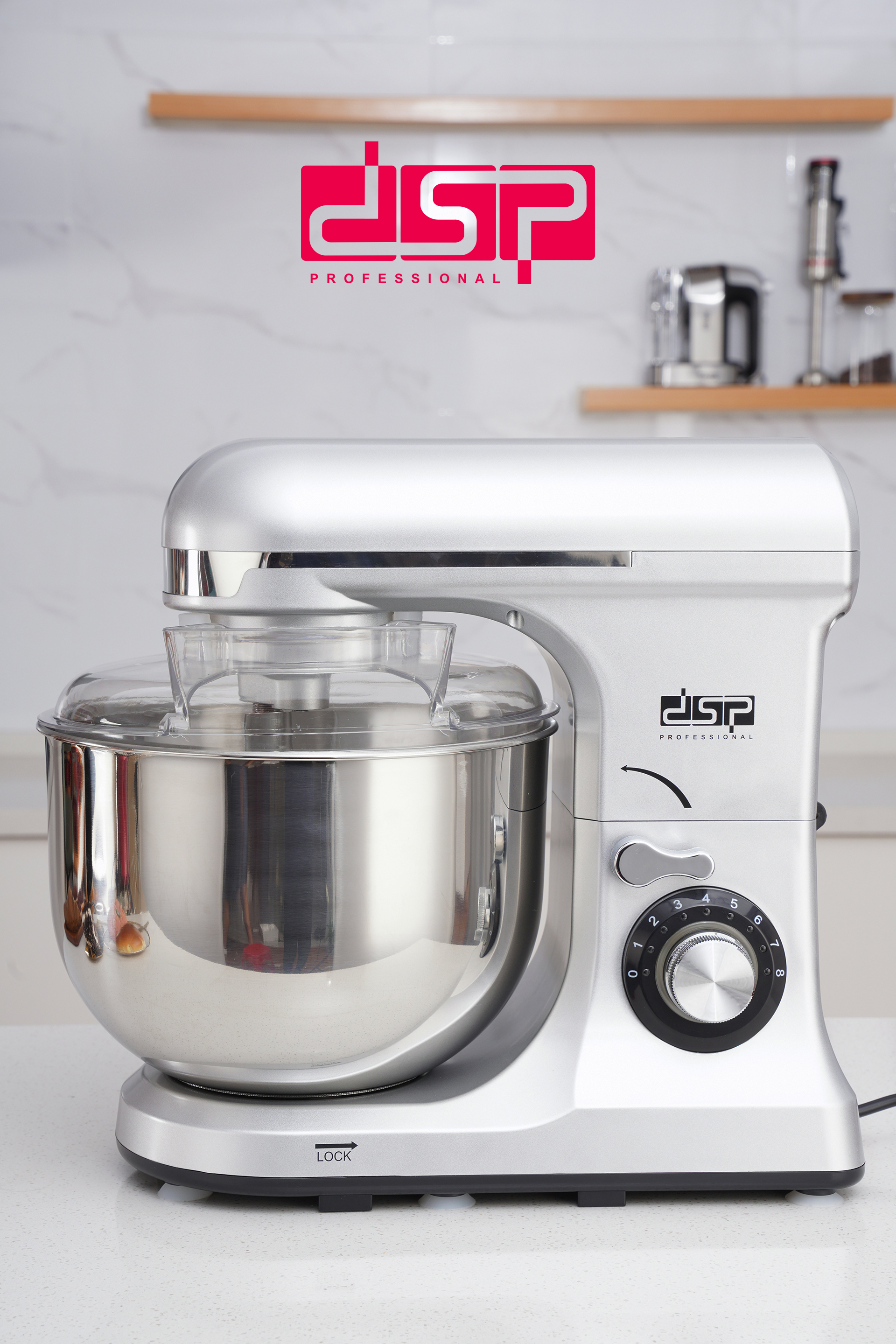
Detailed Solution: The Three Mixing Scales in the DSP Range
Scale 1 — Hand mixers: 250 W to 1000 W
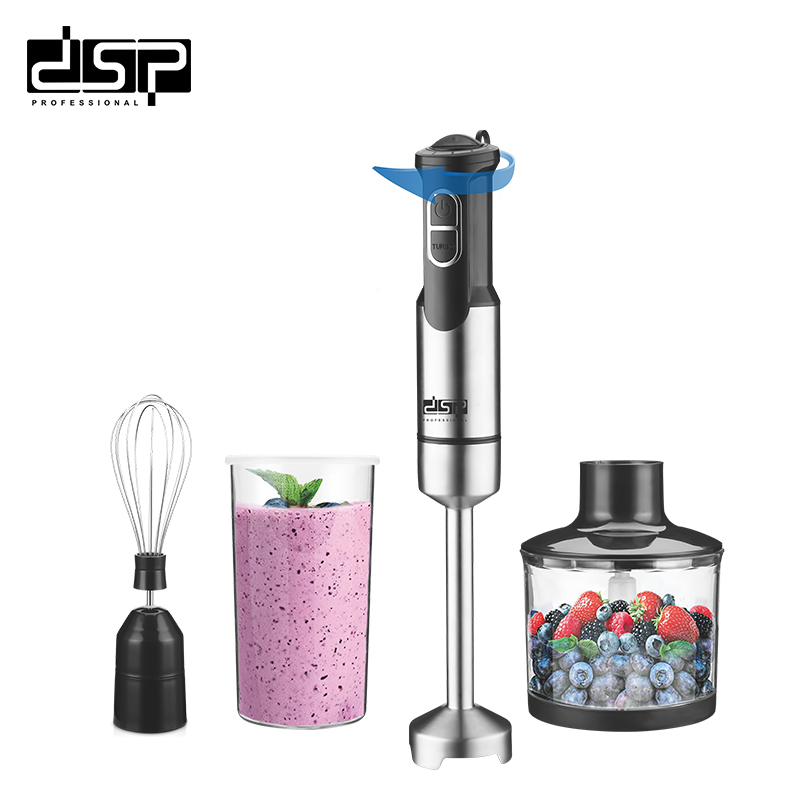
The entry scale is the hand mixer, and the DSP range covers it from a light household unit to a 1000 W variable-speed tool.
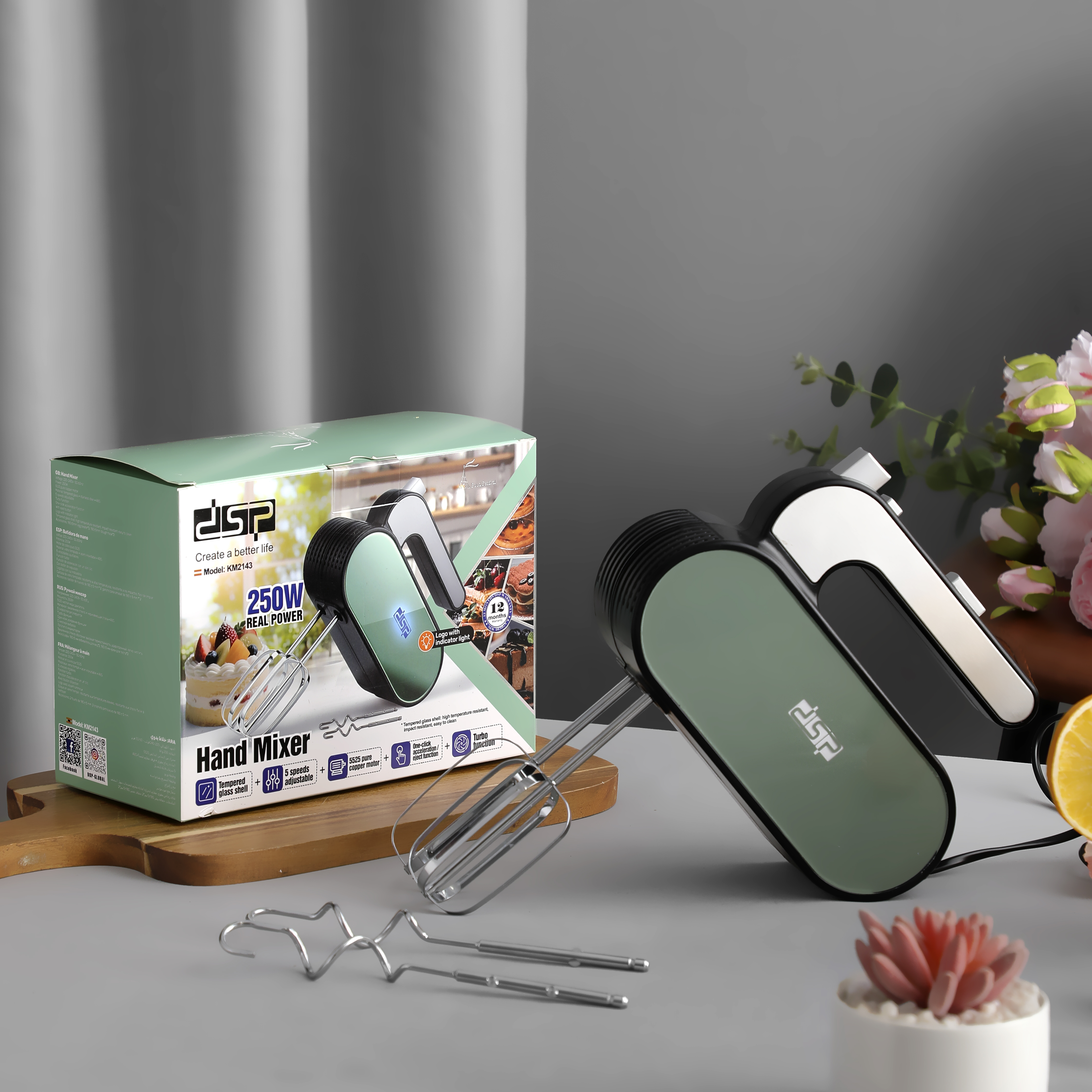
Hand Mixer KM2143 is rated 220–240 V~ 50/60 Hz at 250 W and built around a 5525 pure copper motor. It provides five adjustable speeds, a turbo function, a one-click acceleration function and an eject button, with a logo featuring an indicator light. The housing combines tempered glass, stainless steel and ABS; the tempered glass shell is specified as high temperature resistant, impact resistant and easy to clean. Supplied accessories are two 180±5 mm egg beaters and two 180±5 mm dough hooks — which is what makes this a batter tool with light-dough capability rather than a dough machine.
Hand Mixer KM1153 moves the same format up a class: 1000 W with a 7912 pure copper motor, two speeds plus variable speed control, a turbo function, a stainless steel body, a removable stainless steel stirring bar and stainless steel four-leaf blades. Accessories include a SUS304 beaten egg net, a SUS304 milk frothing bar, a 500 ml PC grinder cup and a 600 ml measuring cup.
Between and around those two models, the range covers intermediate positions: KM1173 (1000 W, DC 8112 pure copper motor, variable speed control), KM1180 (1000 W, DC 7912 pure copper motor, two speeds with variable speed control, plus shredding and slicing capability), KM1117 (700 W, stepless speed change, DC 7712 full copper motor), KM1091 (700 W, 5712 full copper DC motor with a 700 ml cup and 500 ml plastic chopper), KM1142 (500 W, 7712 DC full copper motor, variable speed regulator), KM1139 (500 W, two-speed control, 5724 full copper motor, detachable stainless steel stir bar) and KM1171 (400 W, DC 5624 pure copper motor with turbo and variable speed control).
Across the hand-mixer group, DSP's application data records mixing, blending, whisking and grinding functions with matched equipment such as mixing bowls, whisk attachments and beater or dough-hook accessories, and repeatedly lists food-contact safety and detachable design as special requirements.
Scale 2 — Stand mixer: 1500 W
The stand mixer is the transition platform, because it changes who holds the tool. The base holds the machine, and the operator's hands are free to load, check and stop the mix.
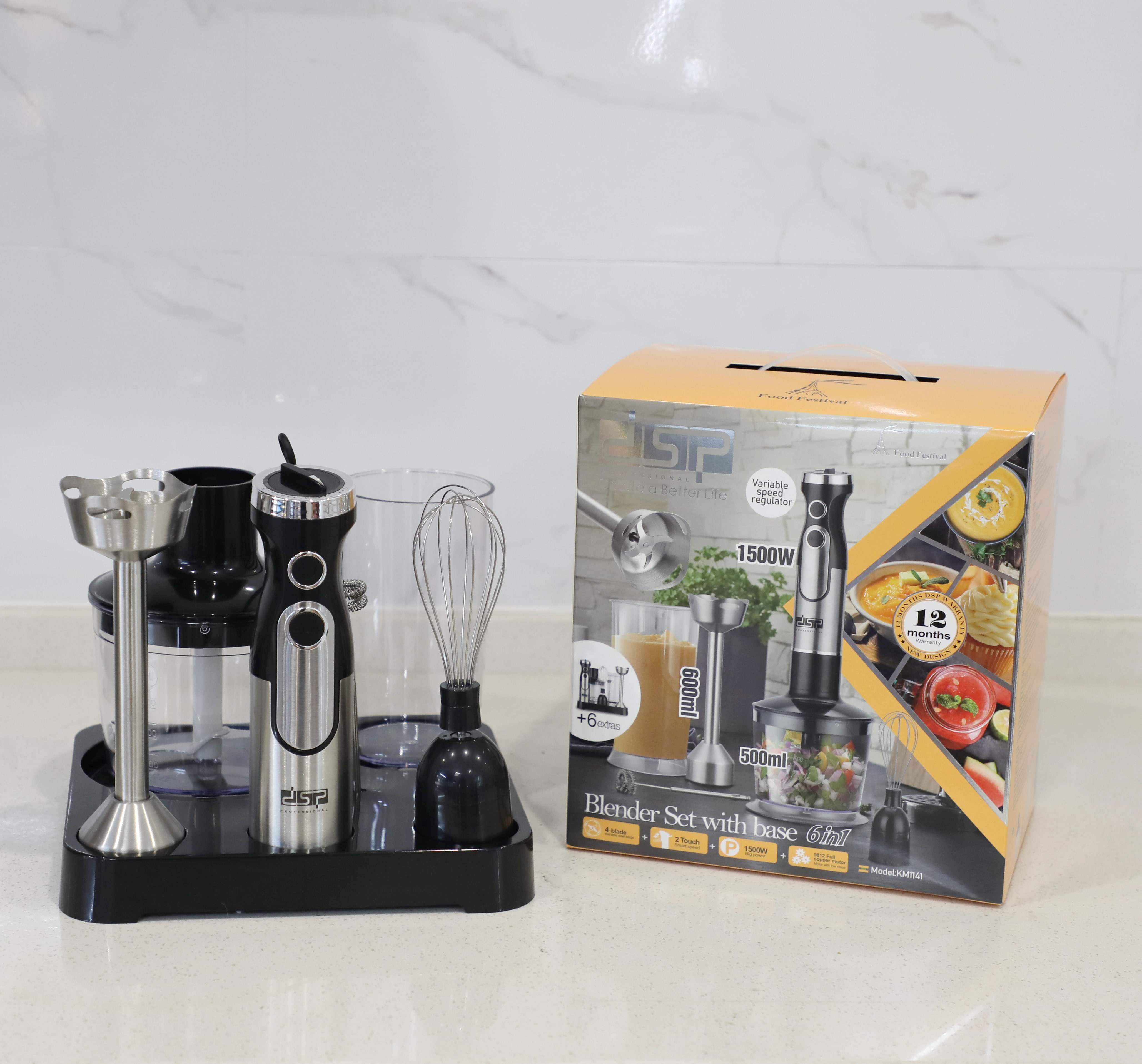
Stand Mixer / Food Blender KM1141 is specified at 220–240 V~ 50/60 Hz, 1500 W, with a 9812 full copper DC motor, two speeds and variable speed control. It uses a stainless steel decorative ring, a stainless steel panel with UV finish, a removable stainless steel stirring bar and stainless steel four-leaf blades. The supplied set is broad for a single unit: a 600 ml grinder cup, a 600 ml measuring cup, a whisk head, a whisk net, a milk frother bar and an injection-moulded base. DSP lists it for household and kitchen appliance use.
For a bakery startup the practical meaning is that a 1500 W stand platform sits above every hand mixer in the range and below the dough mixer, while covering batter, cream, whisking and light dough work from a fixed, hands-free position.
Scale 3 — Planetary dough mixer: 1600 W with a 7 L bowl
The planetary dough mixer is where dough stops being a side task and becomes the core process.
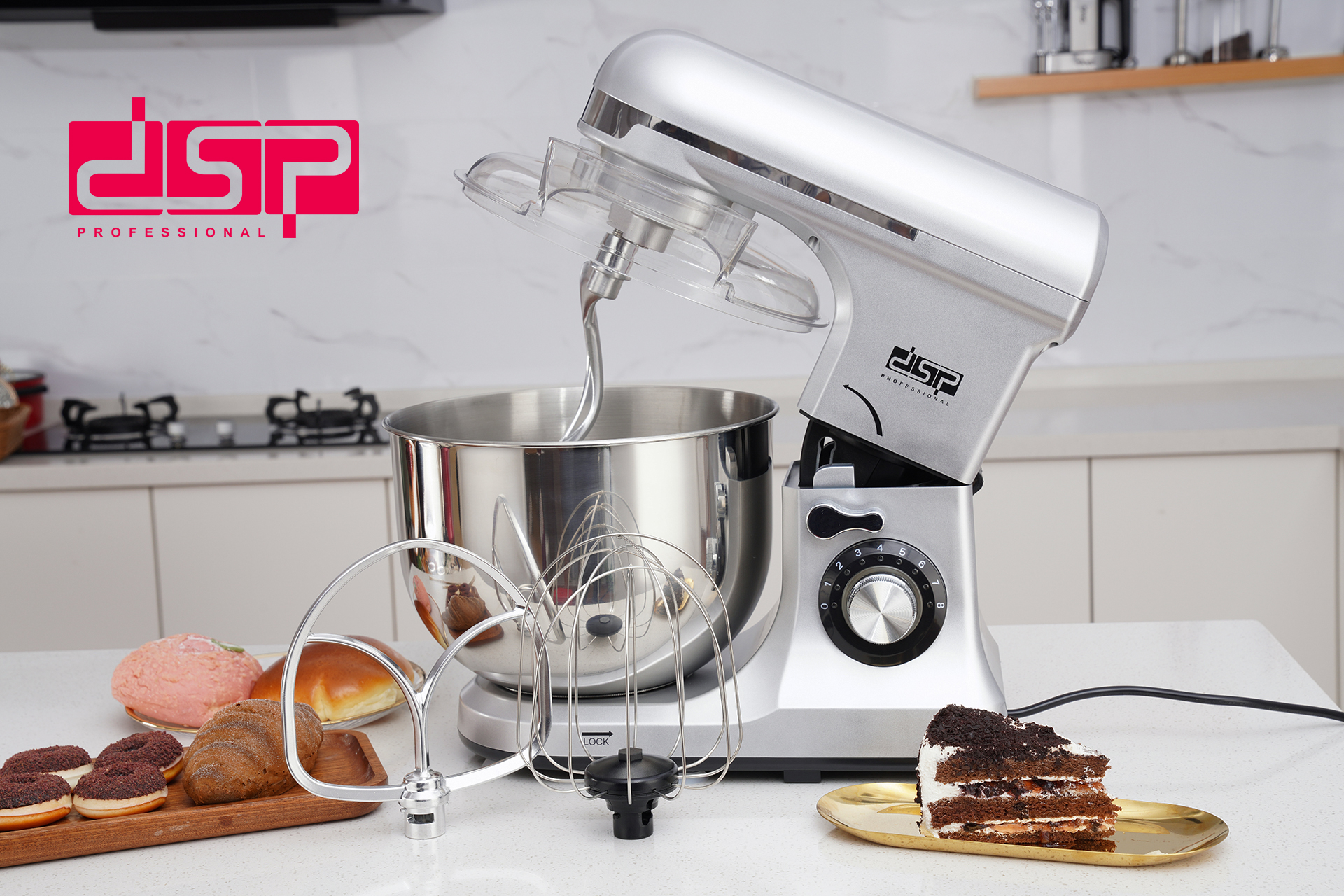
Dough Mixer KM3057 is a planetary mixer specified at 220–240 V~ 50/60 Hz, 1600 W, with a 7 L stainless steel mixing bowl and an 8840AC copper clad aluminum motor. Speed is set through a rotary switch with eight speeds. At this scale the mechanical design matters more than the headline wattage: a lifting mechanism with a safety switch, a transparent bowl cover with an easy-fill window, a planetary rotation design for mixing thoroughly and safely, a steady structure design intended to keep the product working stably over long-term use, and anti-slip feet for stability during mixing. The housing is ABS plastic with sprayed colours. DSP intends the unit for food service, bakery and hospitality.
The matched tooling for dough work in DSP's scenario data is the dough hook, beater and whisk, used under standard or ambient temperature conditions for food dough processing with a mixing and kneading function. Two requirements are flagged for that scenario: a safety lifting mechanism and a non-slip base. DSP records this dough-processing application across markets including Benin, Cape Verde, Cambodia, Saudi Arabia, Botswana, Azerbaijan, Lebanon, Cameroon, Nigeria, Egypt, Somalia, Angola, Tanzania, Mozambique, Portugal, Kyrgyzstan, Armenia, Ghana and Zimbabwe.
Why planetary rotation matters for heavier dough: in a planetary design the mixing tool travels around the bowl while the bowl stays fixed, so the dough is worked from a changing angle rather than from a single static position. Combined with the KM3057's lifting mechanism and anti-slip feet, this is the mechanical reason the platform is better suited to heavier dough loads than a hand-held tool that must be moved manually through the mass.
Step-by-Step Breakdown: Choosing Your Scale in Six Steps
Step 1 — Measure the heaviest single batch, not the average order. Write down the largest quantity of mixture you need to produce in one go, and the mixture type it belongs to. Averages hide the batch that breaks the equipment.
Step 2 — Count batches per session and set a duty-cycle expectation. Mixing in DSP's application data is classified as intermittent operation, and the dough-processing scenario for the planetary dough mixer is specifically listed as an intermittent duty cycle. Plan a work-and-rest rhythm that matches your real session length rather than assuming continuous running.
Step 3 — Classify what you actually mix. Batters, creams and meringues behave very differently from stiff dough. Hand mixers such as the KM2143 (250 W, five speeds, two dough hooks) and the KM1153 (1000 W, variable speed) handle the lighter end; the dough-processing scenario matched to the KM3057 specifies dough hook, beater and whisk as the tooling set.
Step 4 — Choose the platform, not just the wattage. Use the three scales as decision brackets:
- Batter, cream and light dough, low batch count → hand mixer (KM2143, KM1153, KM1173, KM1117).
- Frequent mixing where both hands are needed elsewhere → stand mixer (KM1141, 1500 W, variable speed).
- Dough-heavy production with repeated sessions → planetary dough mixer (KM3057, 1600 W, 7 L stainless steel bowl, eight speeds).
Step 5 — Check the accessories, bowl and safety details against your workflow. Confirm that the unit ships with the tooling you need (dough hook, beater and whisk for dough work; egg beaters and dough hooks on the KM2143; whisk head, whisk net and milk frother bar on the KM1141), that the bowl format suits your batch (7 L stainless steel bowl on the KM3057), and that the safety features match a busy kitchen — safety lifting mechanism, non-slip and anti-slip feet, transparent bowl cover with easy-fill window, detachable parts for cleaning, and food-contact material requirements.
Step 6 — Validate on a sample unit, then confirm the supply path. Test the scale you intend to buy against your heaviest real batch before committing to volume, and confirm the commercial terms with the supplier at the same time.
Use Cases
1. Home-based bakery taking weekend orders
A kitchen producing cakes, cookies and small quantities of light bread normally starts with a hand mixer. The KM2143 (250 W, five speeds, turbo, two 180±5 mm dough hooks) covers batters and light dough, with a tempered glass shell that is easy to clean between sessions. As order volume grows, the KM1153 or KM1173 at 1000 W with variable speed control absorbs longer mixing sessions without changing the working format.
2. Small shop-front bakery with a daily bread and pastry programme
Once dough is produced every day and in repeated sessions, the operator becomes the limiting factor in a hand-mixing setup. The KM3057 planetary dough mixer addresses this directly: a 7 L stainless steel bowl, eight speeds via rotary switch, planetary rotation design, a lifting mechanism with a safety switch, and a steady structure design intended for stable long-term operation. DSP applies this dough-mixing scenario across markets including Nigeria, Egypt, Saudi Arabia, Ghana, Portugal, Tanzania and Cambodia.
3. Micro-catering and event baking
Event work is burst production: several mixes in a short window, then nothing. A 1500 W KM1141 stand mixer with variable speed control and a full accessory set (whisk head, whisk net, milk frother bar, grinder cup, measuring cup) keeps both hands available during peak preparation, while a hand mixer can be kept as a second station for creams and fillings.
4. Recipe development and small-batch testing
Startups testing new products before scaling benefit from flexibility rather than capacity. In the hand-mixer group, the KM1180 (1000 W, DC 7912, shredding and slicing), the KM1091 (700 W with a 700 ml cup and 500 ml plastic chopper) and the KM1117 (700 W, stepless speed change) cover mixing, chopping and emulsifying tasks from one bench.
Comparison Table: Four Mixing Scales, Stated Specifications
| Parameter | Hand Mixer KM2143 | Hand Mixer KM1153 | Stand Mixer KM1141 | Dough Mixer KM3057 |
|---|---|---|---|---|
| Product type | Food mixer / kitchen mixer | Variable speed mixer | Multi-functional stand mixer / kitchen mixer | Planetary mixer (dough mixer) |
| Rated power | 250 W | 1000 W | 1500 W | 1600 W |
| Motor | 5525 pure copper motor | 7912 pure copper motor | 9812 full copper DC motor | 8840AC copper clad aluminum motor |
| Speed control | 5 speeds, turbo, one-click acceleration | 2 speeds with variable speed control, turbo | 2 speeds with variable speed control | Rotary switch, 8 speeds |
| Working format | Hand-held, no fixed bowl | Hand-held, no fixed bowl | Fixed base, hands-free mixing | Fixed base with 7 L stainless steel mixing bowl |
| Key mechanical features | Tempered glass shell (heat resistant, impact resistant, easy to clean), eject button | Stainless steel body, removable stainless steel stirring bar, four-leaf blades | Stainless steel decorative ring and panel (UV), removable stirring bar, four-leaf blades | Lifting mechanism with safety switch, transparent bowl cover with fill window, planetary rotation, steady structure, anti-slip feet |
| Supplied accessories | 2 × 180±5 mm egg beater, 2 × 180±5 mm dough hook | SUS304 beaten egg net, SUS304 milk frothing bar, 500 ml grinder cup, 600 ml measuring cup | 600 ml grinder cup, 600 ml measuring cup, whisk head, whisk net, milk frother bar, base | Dough hook, beater, whisk (matched equipment for dough processing) |
| Intended application | Household / kitchen appliance | Home appliance / kitchenware | Household / kitchen appliance | Food service / bakery / hospitality |
Complementary Equipment for a Bakery Startup Kitchen
Mixing is usually the first scale decision, but it is rarely the only appliance a small bakery adds. Within the same DSP range, adjacent equipment includes the Waffle Maker KC1160 (1400 W, 25.4 × 21.5 cm plate) and KC1234 (750 W, 21.5 × 12.5 cm plate, non-stick coated plate, cool-touch housing), the Electric Toaster KC2080 (650–750 W, 2-slice, seven temperature settings, anti-jamming function) and KC2081 (700–850 W with roasting rack), the Pancake Machine / Crepe Maker KC3051 (1200 W, 30 cm aluminium plate with Teflon non-stick coating), air fryers in three capacities (KB2138 at 1700 W / 8.5 L, KB2180 at 1600 W / 7.0 L, KB2122 at 1350 W / 6 L), and the Contact Grill KC1171 (1200 W with replaceable grill, waffle, sandwich and flat plates).
FAQ
What size mixer does a bakery startup need first?
Size the first mixer by your heaviest single batch and your batch count per session, not by average output. For batters, creams and light dough in household volumes, a hand mixer such as the 250 W KM2143 with two 180±5 mm dough hooks is sufficient. Once mixing time becomes the daily bottleneck, the 1500 W KM1141 stand mixer with variable speed control frees both hands. When dough load and repetition drive the schedule, the 1600 W KM3057 planetary dough mixer with a 7 L stainless steel bowl and eight speeds is the dough-scale platform.
Can a hand mixer knead bread dough?
A hand mixer can work light dough, and the KM2143 is supplied with two 180±5 mm dough hooks for that purpose. The constraint is duty cycle rather than capability: DSP's mixer application data classifies mixing as an intermittent operation, and the 1000 W KM1153 and KM1173 add variable speed control for better handling of heavier mixtures. For repeated, heavier dough batches the operator, not the motor, becomes the limiting factor, which is why a stand or planetary platform is the more appropriate scale at that point.
How long can a planetary dough mixer run continuously?
DSP's dough-processing scenario for the KM3057 lists the operation mode as an intermittent duty cycle rather than continuous running. The unit is also specified with a steady structure design intended to keep the product working stably over long-term use. Production should therefore be planned in sessions with rest intervals rather than as an uninterrupted working day, with session length matched to the eight-speed setting and the dough load actually used.
What bowl capacity and speed settings does the DSP planetary dough mixer have?
The KM3057 dough mixer has a 7 L stainless steel mixing bowl and a rotary switch with eight speeds. It is rated 220–240 V~ 50/60 Hz at 1600 W with an 8840AC copper clad aluminum motor, and includes a lifting mechanism with a safety switch, a transparent bowl cover with an easy-fill window, a planetary rotation design and anti-slip feet. DSP intends it for food service, bakery and hospitality applications, with dough hook, beater and whisk as the matched equipment for dough processing.
How do I validate a mixer before scaling up?
Validation normally starts with a sample unit tested against your heaviest real batch, before committing to production volumes. Sample and specification requests for the KM2143, KM1153, KM1141 or KM3057 can be sent to DSP home appliances at sales-3@dsplife.cn or via WhatsApp on +86 13958409699, and the full product range is summarised in the downloadable DSP product catalogue.
Conclusion: Match the Scale to the Batch, Then Grow Into the Next One
The correct mixing scale for a bakery startup is the smallest platform that reliably handles the heaviest batch you actually produce, at the batch count you actually run. Hand mixers such as the KM2143 (250 W, five speeds, two dough hooks) and KM1153 (1000 W, variable speed) cover batters, creams and light dough. The KM1141 stand mixer (1500 W, variable speed control) removes the operator from the holding position. The KM3057 planetary dough mixer (1600 W, 7 L stainless steel bowl, eight speeds, planetary rotation, lifting mechanism with safety switch) is the scale where heavier dough loads and repeated sessions stop being a constraint.
Two rules keep the decision stable as the business grows. First, treat mixing as an intermittent operation and plan sessions accordingly, because that is how the equipment is specified. Second, validate on a sample against a real batch before committing to the next scale — the cost of testing is far lower than the cost of buying equipment whose capacity you cannot fill, or that you outgrow in one season.
Next Step: Sample, Specification or Catalogue
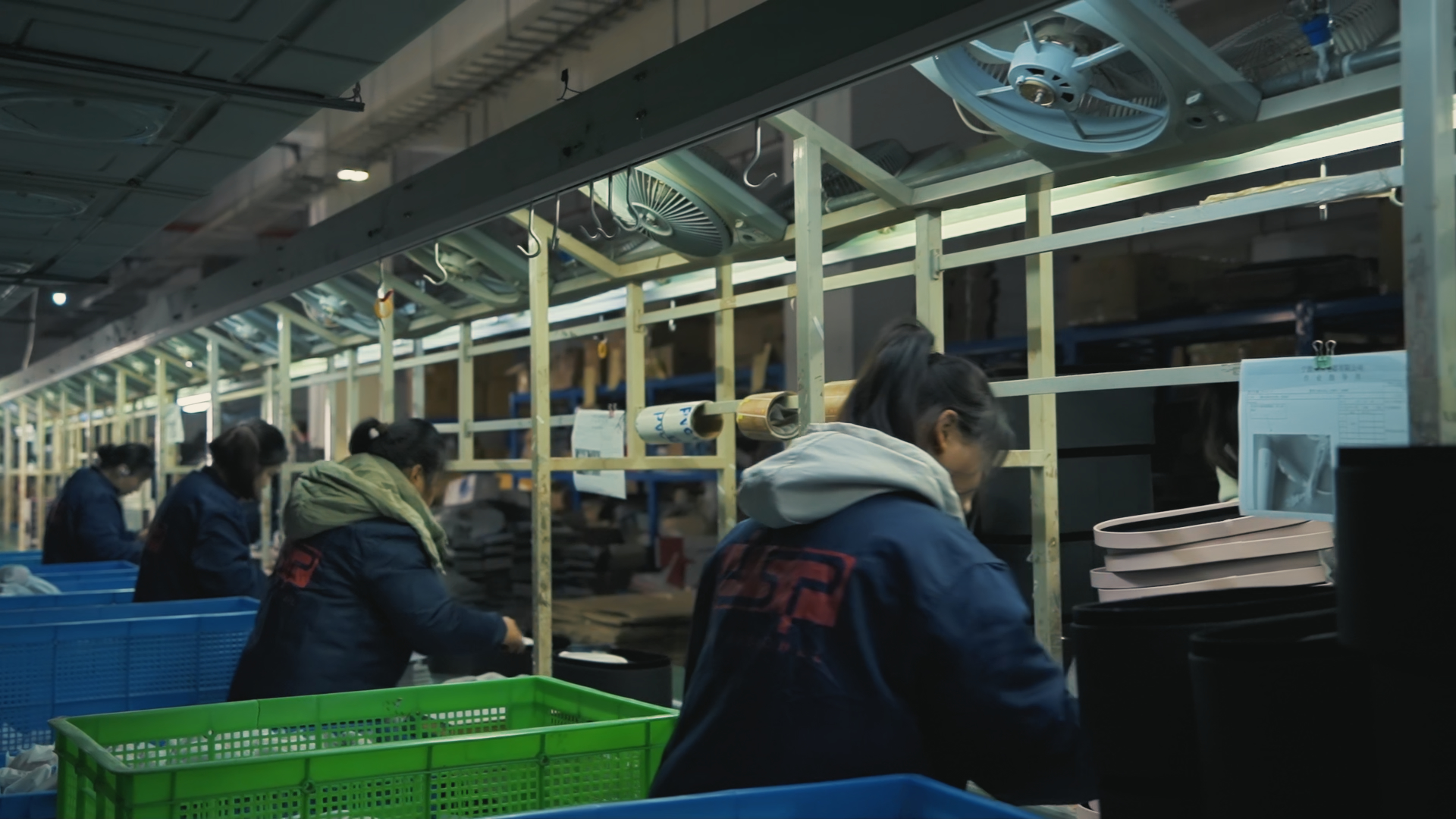
DSP home appliances (Yiwu DSP Electric Appliance Co., Ltd.) manufactures mixers, kitchen appliances and personal care appliances at a 20,000 m² facility in Yiwu, China, with a 30-engineer R&D team and an annual output of 5,000,000 units, exporting 100% of production across North America, South America, Europe, Asia, Africa, Oceania and the Middle East.
Contact: Maggie | Email: sales-3@dsplife.cn | Phone / WhatsApp: +86 13958409699
Address: F3-17160 & 17147, 3st Street 3F, 29th Gate, F District, International Trade City, Yiwu, China
Website: www.dsp-official.com | Product catalogue (PDF): Download the DSP catalogue
Have Questions or Need More Details?
Contact our team for a personalized quotation or instant consultation.
Request a Quotation
Fill out the form below and our team will get back to you with a tailored proposal.
WhatsApp Direct Chat
Prefer to chat in real-time? Message us on WhatsApp for instant assistance & quick answers.
- Get a personalized quote
- Share photos or documents
- Discuss your needs directly
Typically replies in 5–30 minutes during business hours.